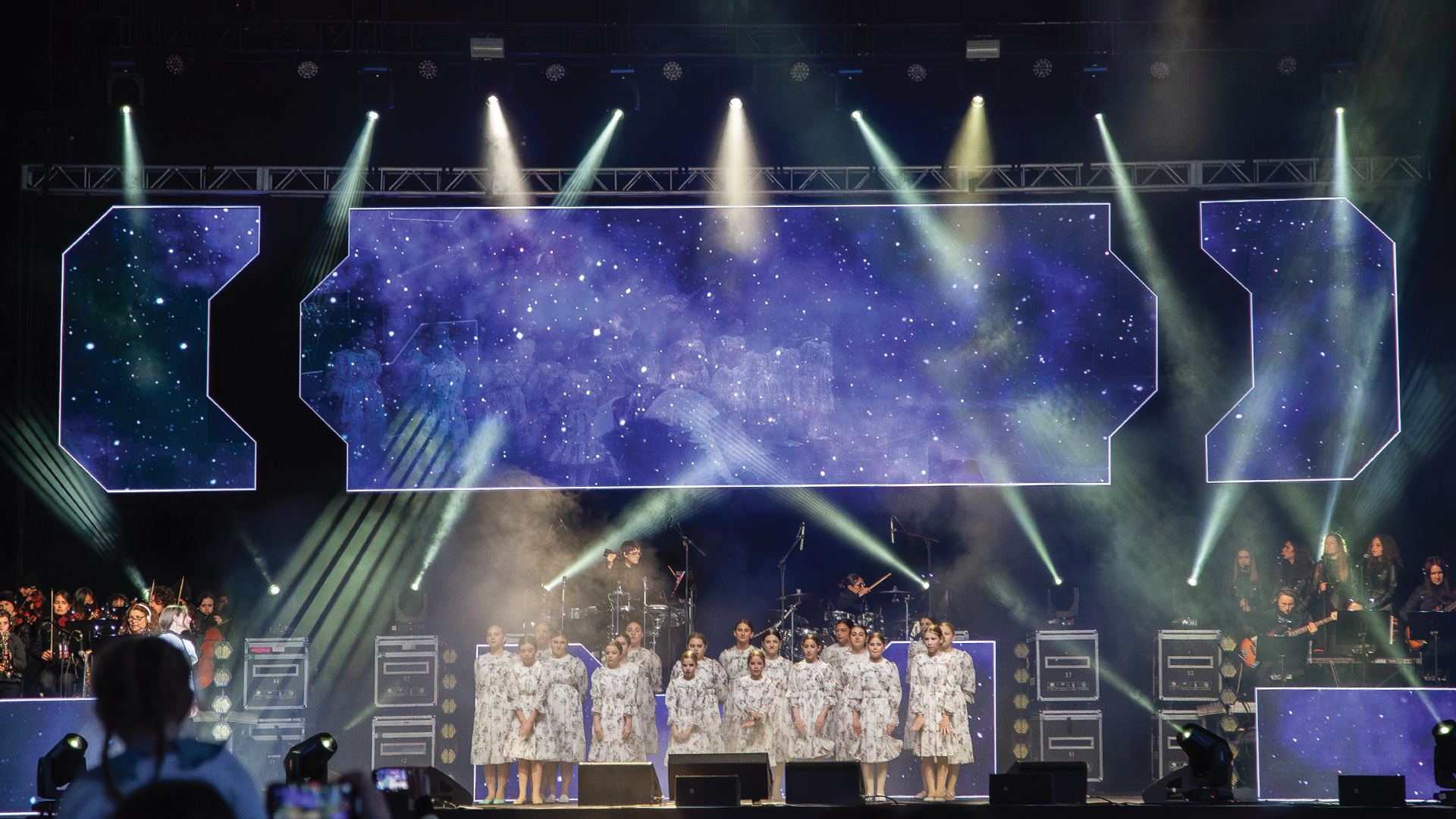
The massive LED video wall behind the stage serves as backdrop, canvas, and increasingly as narrative voice for live productions. When content designers discover the full potential of these enormous displays, the walls transform from passive screens into active participants—visual storytellers that shape audience emotion as powerfully as any performer.
The Evolution of Video Scenography
Early concert video displayed simple graphics and IMAG footage—camera captures of performers magnified for distant audience members. The technology allowed visibility but contributed little to narrative. The U2 Zoo TV tour in 1992 pioneered video as artistic element, fragmenting images across multiple screens to create visual commentary on media saturation.
Contemporary ROE Visual and Absen panels enable narrative sophistication impossible with earlier technology. Pixel pitches measured in millimeters allow cinematic imagery at close viewing distances. HDR processing creates contrast ratios approaching reality. These technical capabilities enable walls to tell stories that complement, enhance, and sometimes transcend the performances they support.
The Media Server Revolution
Professional media servers like Disguise and Notch transform video playback into real-time visual performance. These systems don’t merely display pre-rendered content—they generate, modify, and respond to live input, creating visual narratives that evolve through each performance.
The Notch real-time graphics engine allows content that reacts to audio input, camera tracking, and performer positioning. The wall becomes responsive rather than predetermined, telling stories that incorporate live data into visual output. A drummer’s intensity might drive particle systems; a vocalist’s movement might shift color palettes. The narrative emerges from interaction rather than playback.
Generative Content and Infinite Variation
Generative systems within TouchDesigner and similar platforms create content that never repeats. Mathematical algorithms generate patterns, forms, and movements that follow design principles while producing unique output for each performance. The wall tells a familiar story with infinite variation—recognizable themes expressed through ever-changing visual language.
This generative approach transforms video walls from playback devices into creative instruments. The content designer builds systems rather than files, establishing rules that produce content rather than specifying every frame. The wall becomes collaborator in the creative process, contributing visual ideas within established parameters.
Spatial Storytelling
Modern productions deploy LED panels in configurations that extend beyond simple backdrop walls. Curved surfaces, overhead elements, and floor panels create immersive environments where video surrounds performers and audiences. This spatial deployment enables storytelling that uses architecture rather than just imagery.
The Sphere Las Vegas represents the current pinnacle of immersive LED deployment—a venue where video surface completely envelops the audience. Content designed for such spaces must think architecturally, creating narratives that flow across surfaces and respond to viewer position. The wall doesn’t just tell stories; it becomes the world within which stories unfold.
The Camera Integration Dance
Film and television production increasingly uses LED volumes as virtual production environments. The Stagecraft technology pioneered on The Mandalorian demonstrates how LED walls can tell stories that cameras capture as reality. Content displayed on walls provides lighting, reflection, and background that appears genuine in final footage.
This integration requires content synchronized to camera position through tracking systems that adjust perspective in real-time. The wall tells stories that only the camera sees correctly—perspective-shifted imagery that creates impossible environments through precise coordination. The storytelling happens in the relationship between display and capture.
Emotional Color Science
The Brompton Technology processors driving professional LED walls enable precise color management that serves emotional storytelling. Calibrated color spaces ensure that creative intentions translate accurately to panel output. The subtle blue shift that suggests melancholy, the warm amber that evokes nostalgia, the saturated red that signals danger—all depend on color accuracy that professional processing delivers.
Content designers develop color strategies that arc through performances, using the wall’s precise color reproduction to guide audience emotion. The barely perceptible shift from warm to cool tones might track a narrative from hope to disappointment. The wall tells emotional stories through color language that affects audiences without conscious recognition.
Typography and Text Narrative
LED walls excel at typographic display that incorporates text into visual storytelling. Lyrics displayed behind performers add another narrative layer. Poetic fragments drifting across surfaces create meaning through word and image combination. The wall speaks literally through text while speaking figuratively through surrounding imagery.
The kinetic typography that motion graphics designers create transforms static text into expressive performance. Words that shatter, reform, float, and dance contribute to narratives beyond their linguistic meaning. The wall tells stories through how text moves as much as through what text says.
The Director’s Expanded Canvas
Production video directors increasingly treat LED walls as collaborative storytelling partners. The Ross Carbonite and Blackmagic ATEM switchers that control IMAG also feed content to walls, creating visual narratives that weave live camera capture with designed graphics. The director orchestrates this combination in real-time, making storytelling decisions that shape audience experience moment by moment.
This expanded role requires directors who understand both live camera work and motion graphics. The video director must anticipate performer movement while triggering content cues, balancing immediate reaction with planned sequences. The wall becomes an instrument they play alongside camera operators and content playback technicians.
The Future of Video Narrative
Emerging technologies promise LED storytelling capabilities beyond current imagination. AI-generated content that responds intelligently to performance context. Holographic integration that extends visual narrative into physical space. Interactive systems that incorporate audience input into visual output. The walls will tell stories we haven’t yet imagined, using techniques that don’t yet exist.
The LED walls that became storytellers represent a fundamental shift in production philosophy. These surfaces are no longer supporting technology but creative collaborators visual voices that contribute narrative meaning as significantly as any performer or designer. The stories they tell have become essential to the productions they serve, transforming what began as display technology into genuine artistic medium.
When the wall tells its story well, audiences leave productions with visual memories as vivid as musical ones images that expressed emotions words couldn’t capture, moments where light and color spoke directly to feeling. That’s the power of walls that learned to tell stories.
