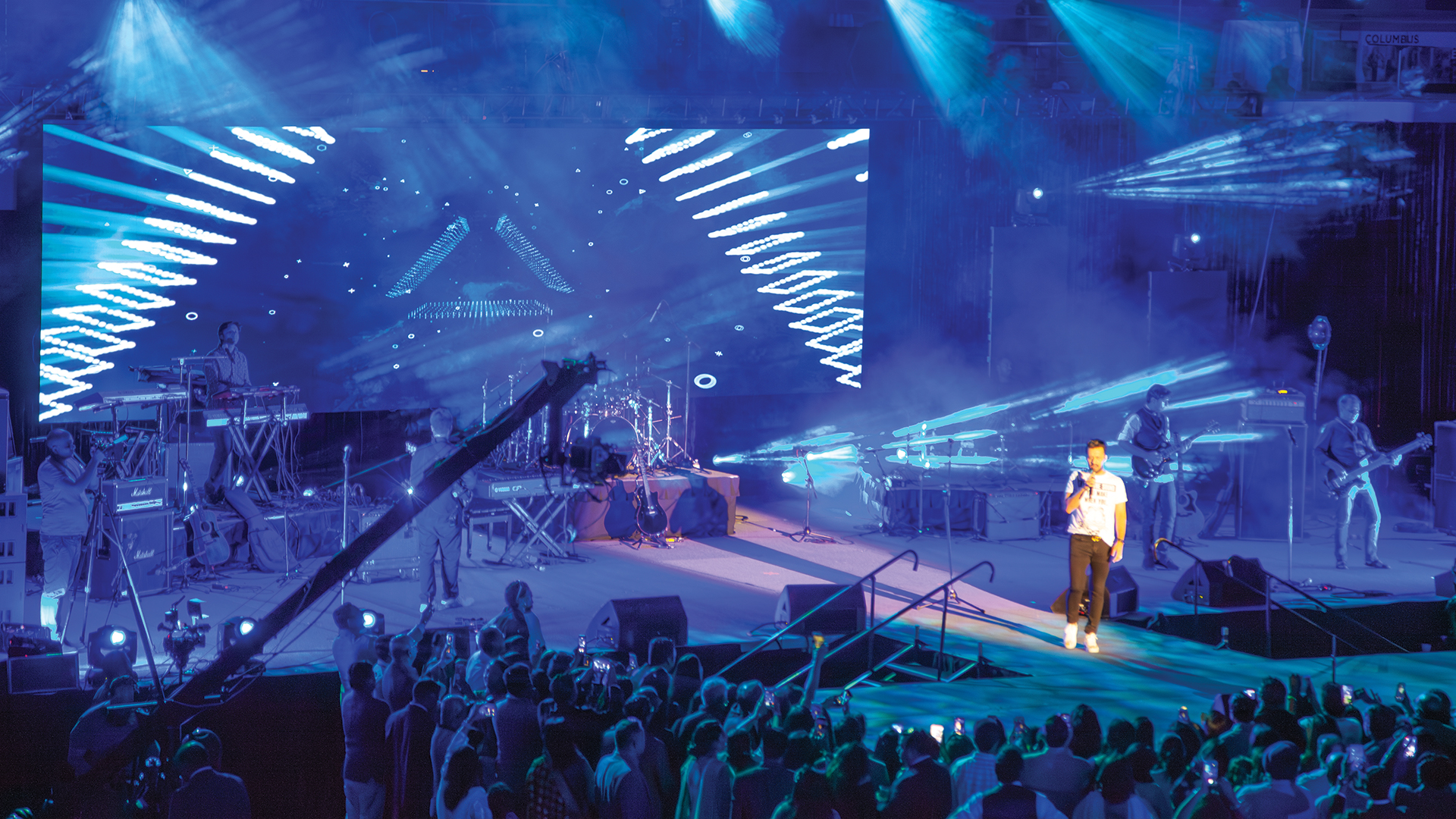
Limited power availability is one of the most consistently underestimated constraints in live production — and one of the most consequential. A venue with inadequate electrical infrastructure doesn’t announce its limitations clearly. It reveals them progressively: a circuit breaker that trips during the audio system power-up, a dimmer rack that causes audible hum in the PA because of inadequate neutral capacity, an LED wall with voltage drop artifacts in the lower panels because the home run cable is too long and too thin. These are symptoms of a power infrastructure problem that should have been diagnosed during the advance production process and addressed before load-in day.
The history of AV in limited-power venues is the history of live production operating in spaces that were never designed for it — historic theaters, converted industrial spaces, outdoor festival sites, hotel ballrooms, and institutional facilities where the electrical infrastructure reflects the building’s original purpose, not the demands of a contemporary production. Understanding how to work effectively in these environments is a core professional competency that separates production companies capable of operating anywhere from those that only function reliably in purpose-built venues.
The Power Audit: Before Anything Else
The first step in any production in a venue with potential power limitations is a comprehensive power audit conducted during the advance process. This audit covers: available amperage at the production feed points, single-phase versus three-phase availability, neutral conductor capacity, ground fault protection configuration, panel-to-production-position cable distances, and any known issues with the facility’s electrical infrastructure.
The production manager should request the venue’s electrical single-line diagram — the document showing the panel configuration, breaker ratings, and feed points — as part of the advance information package. Venues that can’t provide this document are telling you something important about how their electrical infrastructure has been maintained and documented. An electrical contractor familiar with production loads should review this document before the production team commits to a specific equipment list — the power availability may require the list to change.
Power Load Calculation as a Design Requirement
Every production should produce a power load calculation during pre-production that adds the peak operating power of every piece of equipment in the rig, organized by circuit and phase. This calculation is not an approximation — it uses the actual measured or rated power consumption of each piece of equipment, not the marketing specification that often understates peak draw.
Modern production equipment databases like those integrated into Vectorworks Spotlight and Depence include power consumption data for common production fixtures. For equipment not in the database, the CE certification documentation or the equipment’s internal nameplate is the authoritative source. A production that discovers on load-in day that its actual power consumption exceeds the venue’s available capacity faces a choice between reducing the rig size and bringing in supplementary generator power — both of which are expensive and avoidable with correct pre-production arithmetic.
Generator Solutions for Power-Limited Venues
When venue power is insufficient, temporary generator power is the professional solution. Generator sizing for production applications requires accounting for starting current surges — particularly from discharge lamp fixtures and large amplifiers — that can be two to three times the running current and require a generator with adequate headroom above the calculated running load.
Production generator suppliers like Aggreko, Atlas Copco Power Technique, and Sunbelt Rentals offer touring-grade generator solutions with clean sine wave output, automatic voltage regulation (AVR), and low harmonic distortion — specifications that matter enormously for sensitive audio and video equipment that a standard construction generator would damage through its dirty electrical output. The generator-to-distribution cable run must be correctly sized for the total load and the distance to avoid voltage drop that causes its own set of performance problems.
Power Distribution and Phase Balancing
On three-phase power supplies, phase balancing — distributing the production load as evenly as possible across all three phases — is both a performance optimization and a safety requirement. Unbalanced three-phase loads cause neutral current to flow in the neutral conductor, which can create hum and noise in audio systems, overload the neutral conductor, and in severe cases cause neutral conductor failure. A production power distribution system from Lex Products, Motion Laboratories, or Socapex should include phase monitoring instrumentation that allows the production electrician to verify balance before and during the show.
Managing Audio Ground Issues in Old Buildings
Old buildings with inadequate grounding infrastructure are a primary source of audio ground noise problems — the 60Hz hum (50Hz in Europe) that appears in a PA system when there is a ground potential difference between different pieces of equipment in the signal chain. This is not a signal chain problem — it is an electrical infrastructure problem that manifests in the signal chain.
The professional audio toolkit for managing ground noise in limited-power venues includes: Jensen Transformers and Radial Engineering J-ISO direct boxes for galvanic isolation of problem inputs; ground lift switches on direct boxes and signal isolators; and star-ground wiring practices that route all equipment grounds to a single common point rather than allowing ground loops to form through the building’s infrastructure. These solutions manage the symptom — but the root cause is a building with inadequate safety ground infrastructure that should be documented and reported rather than silently compensated for.
LED Wall Power Management in Limited Supply Environments
LED video wall systems present a specific power management challenge: their power consumption varies significantly with content — a full-white image consumes several times more power than a predominantly black image. In a venue with limited power capacity, this dynamic consumption can cause voltage fluctuations that affect other production equipment on the same supply. LED wall systems from ROE Visual, Absen, and Leyard include maximum brightness limiting features that cap power consumption at a defined level — a capability that the video system designer should configure explicitly in limited-power environments rather than leaving the wall to consume whatever the content demands.
